Welcome to Krubo Motor (Tianjin) Co., Ltd
 whatsapp
Welcome to Krubo Motor (Tianjin) Co., Ltd
whatsapp

💫 Elevate your AHU(Air Handling Units) with Krubo EC backward centrifugal bracket fans!
Published:2026-05-07 Browse:584
Elevate your AHU(Air Handling Units) with Krubo EC backward centrifugal bracket fans! Engineered for high static pressure, stable airflow, and premium EC motor efficiency, our fans deliver exceptional energy savings and consistent performance for commercial & industrial AHU systems.
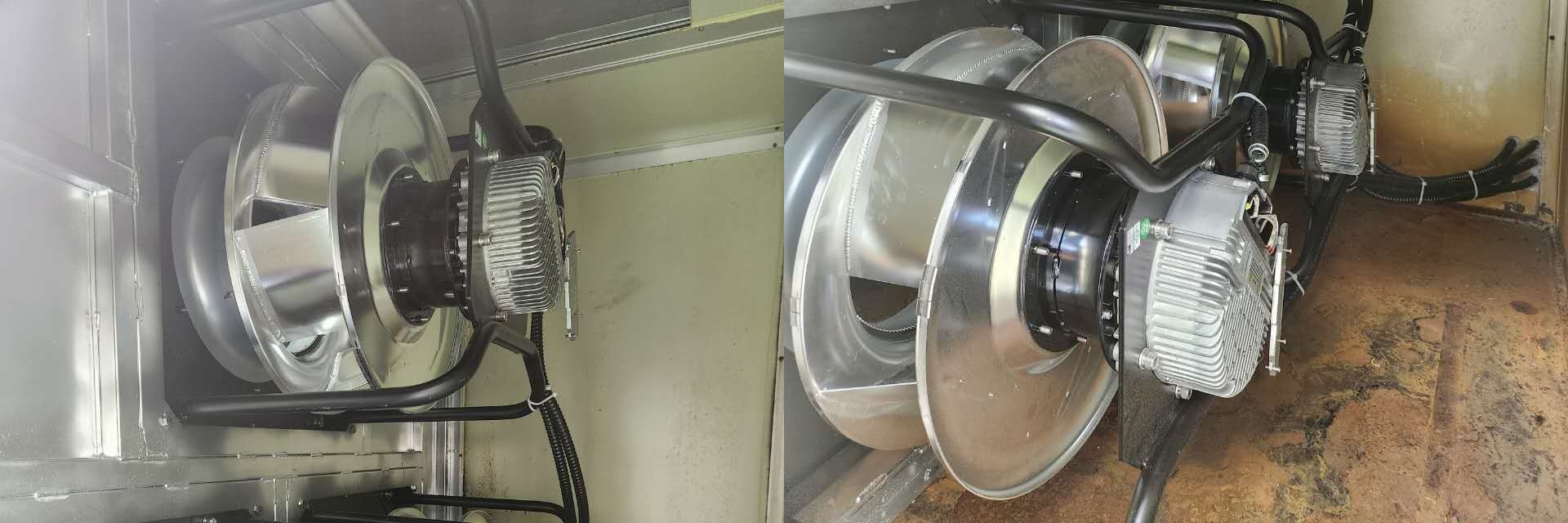
Designed for seamless integration, Krubo backward centrifugal fans feature low-noise operation, wide voltage compatibility, and intelligent speed control. As a professional fan manufacturer, we provide reliable, long-lasting solutions to optimize AHU efficiency, reduce operating costs, and enhance overall HVAC system performance globally.
These installation precautions are formulated from the factory technical perspective, aiming to ensure the safe, stable and efficient operation of the EC backward centrifugal fan with bracket, avoid equipment damage and potential safety hazards caused by improper installation, and meet the relevant industrial operation standards and equipment technical requirements.
·Check the consistency between the fan parameters and the system requirements. Verify that the rated air volume, total pressure, rated power and other parameters on the fan nameplate are consistent with the factory design drawings, and ensure that the fan air volume reserves 10% margin and the wind pressure is greater than the total resistance of the system (including the sum of the resistance of pipelines, filters, heat exchangers, etc.) to avoid inefficient operation caused by mismatched parameters.
·Inspect the integrity of the fan and bracket. Check whether the fan impeller, casing, motor, bracket and other components are damaged, deformed or missing during transportation. Manually rotate the impeller to ensure there is no jamming, friction or abnormal noise; check that the bracket welding is firm, without welding cracks or missing welding, and the surface is free of serious rust.
·Prepare installation tools and accessories. Equip with torque wrenches, spirit levels, dial indicators, wire strippers, multimeters and other professional tools that meet the specifications; confirm that the supporting vibration isolation pads (load-bearing capacity ≥ 1.5 times the fan weight), connecting bolts, wiring terminals (temperature resistance ≥ 105℃) and other accessories are complete and meet the technical requirements, and do not use ordinary accessories instead of special ones.
·Preprocess the installation environment. The installation position shall reserve at least 30cm of maintenance space to facilitate later inspection and maintenance of wiring terminals and control boards; the area within 1.5 meters in front of the air inlet shall be free of obstacles to avoid air flow disorder; the installation surface shall be clean and free of dust, debris and oil stains, and the ambient temperature shall be controlled between -10℃ and 45℃, avoiding corrosive gas, high temperature and humid environments (special models excepted).
·Confirm the installation foundation strength. The installation foundation (concrete base or steel structure) shall have sufficient strength to bear the total weight of the fan and bracket, and the position of the reserved anchor bolt holes shall match the installation holes of the bracket, with the hole depth and diameter meeting the design requirements.
·Level the bracket. Place the bracket on the installation foundation, use a spirit level to calibrate the horizontal and verticality, the horizontal error shall not exceed 0.2mm/m, and the vertical error shall not exceed 1°. If the levelness is not up to standard, adjust it with shim irons (no more than 3 pieces per group, and weld firmly after adjustment), and it is strictly prohibited to force adjustment by tightening bolts to avoid bracket deformation.
·Firmly fix the bracket. Tighten the connecting bolts between the bracket and the foundation in diagonal order to ensure uniform stress. The tightening torque shall comply with the equipment manual requirements, and lock washers shall be added to prevent bolt loosening during fan operation. For large fans (weight ≥ 50kg), spring shock absorbers shall be installed on the bracket to reduce vibration transmission.
·Hoist the fan correctly. Use hoisting equipment that matches the weight of the fan, select the special lifting ring on the fan body as the hoisting point, and avoid directly hoisting the impeller or motor to prevent component deformation. The hoisting process shall be stable, and collision between the fan and the bracket or other objects shall be avoided.
·Install the fan on the bracket. Place the fan on the bracket stably, align the fan base with the bracket installation holes, and fix it with bolts. The bolts shall be symmetrically arranged, and the tightening torque shall be controlled within the specified range (for small and medium-sized fans, M8 bolts are generally used, with torque of 25-30N·m) to avoid damaging the fan base or bracket.
·Install vibration isolation measures. Place 4 special vibration isolation pads symmetrically at the four corners between the fan base and the bracket, ensuring that the holes of the vibration isolation pads are aligned with the installation holes, so as to reduce the vibration generated by the fan during operation, avoid resonance with the bracket and foundation, and reduce noise and equipment wear.
·Check the clearance between components. After installation, check the clearance between the impeller and the casing, which shall meet the requirements of the equipment manual (usually 3-5mm), and ensure that there is no friction between the impeller and other components during operation; check the coaxiality of the fan main shaft and the motor shaft, the radial displacement shall not exceed 0.05mm, and the axial inclination shall not exceed 0.2mm/m.
·Follow the principle of "straight in and straight out" for air flow path. The diameter of the air inlet and outlet pipelines shall be consistent with the diameter of the fan air inlet and outlet, with a deviation not exceeding 5%, avoiding sudden diameter change. If the air inlet is exposed, a protective net shall be installed, and the mesh area shall be ≥ 1.2 times the area of the air inlet to prevent blockage.
·Ensure the tightness of pipeline connection. Use sealing gaskets or sealant to seal the connection between the fan and the pipeline to avoid air leakage, which will lead to air volume loss and reduced operation efficiency. The pipeline shall be supported independently, and it is strictly prohibited to apply the pipeline weight to the fan casing to avoid casing deformation.
·Optimize the pipeline layout. The air outlet shall be kept away from walls or obstacles, with a distance ≥ 1.5 times the diameter of the air outlet; if the pipeline needs to turn, the curvature radius of the elbow shall be ≥ 1.5 times the diameter of the pipeline to reduce local resistance and avoid air flow backflow.
·Ensure safe electrical operation. Before wiring, cut off the power supply and verify that the power is off with a multimeter. The operator shall have corresponding professional qualifications and be familiar with the fan wiring diagram and safety regulations.
·Standardize wiring operation. Connect the live wire (L), neutral wire (N) and ground wire (PE) to the corresponding terminals of the fan correctly. The wire diameter shall be ≥ the cross-sectional area corresponding to the rated current of the fan (for example, 2.5mm² copper core wire shall be used for 1.5kW fan). After wiring, wrap the connection with insulating tape to avoid short circuit.
·Avoid electromagnetic interference. The speed control lines (such as 0-10V, PWM signals) shall be routed separately, and the distance from the high-voltage cable shall be ≥ 30cm to prevent electromagnetic interference from causing speed fluctuation and affecting operation stability.
·Strengthen protection measures. In humid environments, apply sealant at the junction box to improve the protection level to IP54, but do not seal the fan heat dissipation holes to avoid overheating of the control board; in dusty environments, install a detachable filter at the air inlet, with filter resistance ≤ 50Pa, and clean it regularly (once a week).
·Carry out no-load trial operation first. After installation and wiring, conduct no-load trial operation for 10-15 minutes, check whether the fan runs smoothly, whether there is abnormal noise, vibration or overheating, and whether the rotation direction of the impeller is consistent with the direction marked on the fan casing. If any abnormality is found, stop the machine immediately for inspection and troubleshooting.
·Perform load trial operation. After the no-load trial operation is normal, connect the pipeline for load trial operation, and monitor the air volume, wind pressure, current, voltage and other parameters to ensure they are within the rated range. If the parameter deviation exceeds 10%, check whether there is air leakage in the pipeline or incorrect parameter setting.
·Verify the stability of the control system. Test the speed regulation function of the EC fan, check whether the speed regulation is stable and accurate, and whether the control signal is normal. Record the operation parameters during the trial operation for future maintenance and reference.
·Strictly abide by safety operating procedures. During installation and commissioning, it is forbidden to put hands, tools or other objects into the fan casing to avoid personal injury; during the operation of the fan, it is not allowed to disassemble or maintain the equipment without authorization.
·Do a good job in daily maintenance records. After installation and commissioning, record the installation parameters, trial operation results, and problems found and handled in detail to form a complete technical file for later equipment maintenance and fault diagnosis.
·Regularly inspect and maintain. After the fan is put into operation, regularly check the tightness of bolts, the wear of vibration isolation pads, the cleanliness of the impeller and filter, and the operation status of the electrical system, so as to find and solve potential problems in time and extend the service life of the equipment.
·Comply with relevant regulations. The installation, commissioning and operation of the fan shall comply with local industrial regulations, safety standards and the requirements of the equipment manual. Any modification of the fan and bracket without authorization is prohibited, which may lead to equipment failure and safety hazards.


Free Service Hotline:
+86 (22) 2210 6768 +86 177 0229 2068

Email:sales@krubofan.com

Address:38 Fagang South Road, Jinnan District, Tianjin
Copyright @ Kolbo Motor (Tianjin) Co., Ltd. Filing No.: JinICPBei 2022008051-1
 whatsapp