Welcome to Krubo Motor (Tianjin) Co., Ltd
 whatsapp
Welcome to Krubo Motor (Tianjin) Co., Ltd
whatsapp

How to Select the Right EC Fan Model Based on Your Requirements
Published:2026-05-30 Browse:549
Contents:
Introduction: Why Choosing the Right EC Fan Matters
Step 1: Define the Core Application & Operating Environment
2.1. Primary Application Scenario
2.2. Environmental Conditions: Temperature, Humidity, Altitude & Corrosives
Step 2: Identify Critical Performance Parameters
3.1. Airflow (CFM/m³/h) Requirements
3.2. Static Pressure (Pa) & System Resistance
3.3. Noise Level & Acoustic Constraints
Step 3: Select the Optimal EC Motor & Control Features
4.1. EC vs. AC: Why EC Motors Dominate Modern Applications
4.2. Control Interfaces: 0-10V, PWM, Modbus, & Beyond
4.3. Energy Efficiency, IE Ratings & Power Supply Compatibility
Step 4: Evaluate Mechanical & Installation Constraints
5.1. Fan Type Selection: Axial, Centrifugal, or Cross Flow?
5.2. Physical Dimensions & Form Factor Limitations
5.3. Mounting Orientation, IP Rating & Material Requirements
Step 5: Validate with Krubo’s Engineering Support & Testing
Common Pitfalls to Avoid in EC Fan Selection
Conclusion: Partner with Krubo for Tailored EC Fan Solutions

1. Introduction: Why Choosing the Right EC Fan Matters
EC (Electronically Commutated) fans have revolutionized modern ventilation, HVAC, and industrial systems, offering unmatched energy efficiency, precise control, and long-term reliability. However, even the most advanced EC fan will underperform—or fail entirely—if it is not matched to the customer’s specific application requirements.
For OEMs, system integrators, and equipment builders, selecting the wrong fan can lead to:
Reduced system efficiency and higher operational costs
Inadequate airflow or pressure, compromising equipment performance
Excessive noise levels that violate project specifications
Premature fan failure due to environmental or mechanical incompatibility
At Krubo, as a leading Chinese manufacturer of high-performance EC fans, we work with clients worldwide to simplify the selection process. This guide walks you through the key steps to identify the ideal EC fan model for your customer’s needs, ensuring optimal performance, reliability, and cost-effectiveness.
2. Step 1: Define the Core Application & Operating Environment
The first step in EC fan selection is to fully understand where and how the fan will operate.
2.1. Primary Application Scenario
Different industries and equipment types demand distinct fan characteristics:
HVAC & Building Ventilation: Fan coil units (FCUs), air handling units (AHUs), and rooftop units require balanced airflow, low noise, and compatibility with building management systems (BMS).
Data Centers & IT Cooling: High-static pressure fans for server racks and CRAC units, with redundant operation and precise speed control.
Medical & Laboratory Equipment: Ultra-quiet, cleanroom-compliant fans with stable airflow for incubators, fume hoods, and medical devices.
Industrial & Process Cooling: High-temperature, high-pressure fans for ovens, drying systems, and industrial machinery.
Renewable Energy (BESS, Solar Inverters): Rugged, IP-rated fans for battery energy storage systems, operating in extreme temperatures.
2.2. Environmental Conditions
Environmental factors directly impact fan performance and lifespan:
Operating Temperature Range: Standard EC fans typically operate between -20°C to +60°C, but high-temperature applications (e.g., industrial ovens) require specialized motor and insulation designs.
Humidity & Moisture: High-humidity or outdoor environments demand IP54/IP65-rated fans with corrosion-resistant coatings (e.g., Krubo’s black electrophoretic finish).
Altitude: At elevations above 1,000m, air density decreases, requiring higher-speed or larger fans to maintain required airflow.
Corrosive Gases/Dust: Applications with chemical fumes or heavy dust require sealed motors and stainless steel components to prevent degradation.
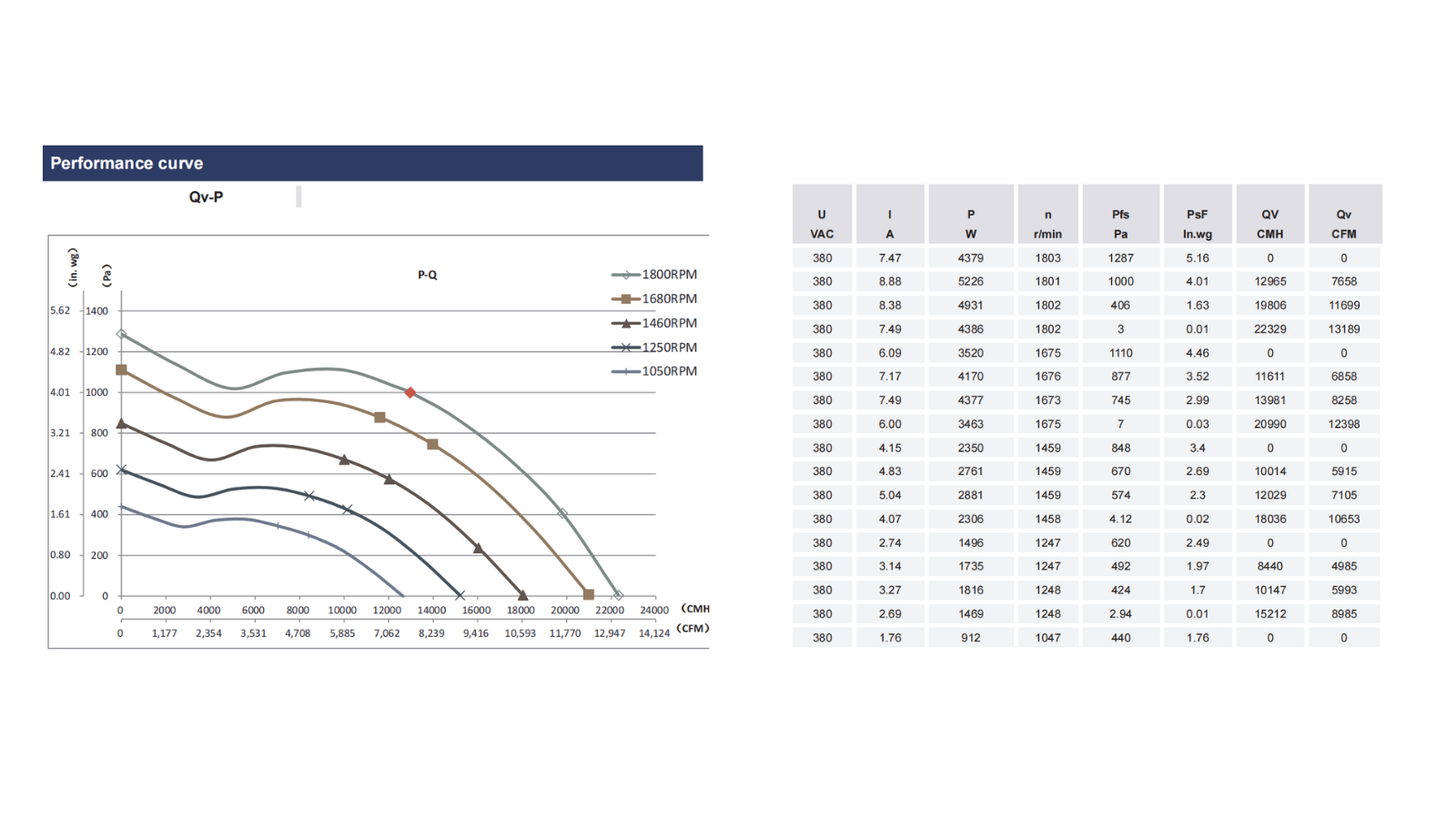
3. Step 2: Identify Critical Performance Parameters
Once the application is defined, focus on the three non-negotiable performance metrics: airflow, static pressure, and noise.
3.1. Airflow (CFM/m³/h) Requirements
Airflow is the volume of air the fan must move to meet the system’s needs. This is determined by:
The equipment’s cooling/heating load (e.g., BTU for HVAC, kW for electronics)
The required air changes per hour (ACH) for enclosed spaces
The density of the air (adjusted for temperature/altitude)
At Krubo, we provide detailed airflow curves for all our EC fans, allowing you to verify performance at different operating speeds.
3.2. Static Pressure (Pa) & System Resistance
Static pressure is the fan’s ability to push air through the system’s resistance, including filters, ducts, heat exchangers, and grilles. A common mistake is selecting a fan based solely on free-air airflow, ignoring the pressure drop of the customer’s system.
For example:
Axial fans are ideal for low-resistance applications (e.g., direct air cooling) with pressures below 200 Pa.
Centrifugal fans (forward/backward curved) are designed for high-resistance systems (e.g., ducted HVAC) with pressures up to 1,500 Pa+.
Krubo’s engineering team can help you calculate system resistance and recommend a fan that delivers the required airflow at the correct static pressure.
3.3. Noise Level & Acoustic Constraints
Noise is a critical factor in applications like offices, hotels, and medical facilities. Fan noise is measured in dB(A) and depends on:
Fan speed (higher speeds = higher noise)
Blade design (aerodynamic impellers reduce turbulence)
Mounting configuration (vibration isolation minimizes structure-borne noise)
Our EC fans feature optimized impeller designs and variable speed control, allowing you to reduce noise by adjusting fan speed without sacrificing performance.
4. Step 3: Select the Optimal EC Motor & Control Features
EC motors are the heart of modern fans, offering superior efficiency and control compared to traditional AC motors.
4.1. EC vs. AC: Why EC Motors Dominate
Feature | EC Fans | AC Fans |
Energy Efficiency | Up to 60% more efficient at partial loads | Fixed-speed efficiency, drops at partial loads |
Speed Control | Full 0-100% variable speed | Limited (e.g., 3-speed taps) |
Power Factor | >0.95 | 0.6-0.8 |
Lifespan | 50,000+ hours (brushless design) | 20,000-30,000 hours (brush wear) |
4.2. Control Interfaces
Choose a control method that aligns with the customer’s system integration needs:
0-10V/PWM: Simple, cost-effective control for most HVAC and industrial applications.
Modbus RTU/TCP: For smart building integration and remote monitoring.
Thermostat Control: Direct temperature-based speed adjustment for cooling systems.
Custom Protocols: Krubo supports custom control interfaces for specialized OEM applications.
4.3. Energy Efficiency & Power Supply
IE5 Efficiency: Krubo’s EC fans meet the highest global efficiency standards, reducing energy costs for end-users.
Wide Voltage Compatibility: 100-240V AC or 380V three-phase options to support global markets.
Power Factor Correction (PFC): Built-in PFC for stable operation in fluctuating power environments.
5. Step 4: Evaluate Mechanical & Installation Constraints
Even the highest-performing fan will fail if it doesn’t fit the customer’s physical and installation requirements.
5.1. Fan Type Selection
Choose the right fan type based on the application:
Axial Fans: Best for high airflow, low static pressure (e.g., IT cooling, ventilation).
Centrifugal Fans: Ideal for high static pressure, ducted systems (e.g., HVAC, industrial process cooling).
Cross Flow Fans: Perfect for wide, uniform airflow (e.g., fan coil units, air curtains).
5.2. Physical Dimensions & Form Factor
Space Limitations: Slim, compact designs for low-profile equipment (e.g., 25mm thin cross flow fans for FCUs).
Custom Sizes: Krubo offers custom impeller diameters, lengths, and housing designs to fit unique form factors.
5.3. Mounting Orientation & Protection
Mounting: Vertical, horizontal, or custom mounting options to fit the customer’s equipment layout.
IP Rating: IP20 (indoor), IP54 (dust/water-resistant), or IP65 (outdoor/harsh environments).
Materials: Galvanized steel, black electrophoretic coating, or stainless steel for corrosion resistance.
Certifications: CE, UL, and RoHS compliance for global market access; ATEX/IECEx options for hazardous environments (e.g., mining, chemical processing).
6. Step 5: Validate with Krubo’s Engineering Support & Testing
At Krubo, we don’t just sell fans—we partner with you to ensure the perfect fit. Our support includes:
Free Technical Consultation: Share your customer’s requirements, and our engineers will recommend 2-3 optimal fan models.
Performance Simulation: We provide airflow-pressure curves, noise data, and efficiency reports to validate performance.
Prototype Testing: Order sample fans for integration testing in your customer’s equipment.
Customization Services: Modify motor specs, control interfaces, or materials to meet unique requirements.
Post-Sale Support: Global technical support and warranty coverage for all Krubo fans.
7. Common Pitfalls to Avoid
Ignoring System Resistance: Never select a fan based solely on free-air airflow—always account for filters, ducts, and heat exchangers.
Overlooking Environmental Limits: Operating a standard fan in high-temperature or corrosive environments will shorten its lifespan.
Choosing the Wrong Control Interface: Ensure the fan’s control method is compatible with the customer’s BMS or equipment.
Underestimating Noise Requirements: A fan that meets airflow specs may fail acoustic tests at the customer’s site.

8. Conclusion: Partner with Krubo for Tailored EC Fan Solutions
Selecting the right EC fan requires balancing performance, environmental, mechanical, and control requirements. At Krubo, we combine decades of fan manufacturing expertise with a customer-first approach to simplify this process.
As a leading Chinese manufacturer of EC fans, we offer a full range of axial, centrifugal, and cross flow fans, plus custom solutions for OEMs across HVAC, industrial, medical, and renewable energy sectors.
Ready to find the perfect EC fan for your customer’s application?
Contact our Sales or Engineering team today to start your consultation:
Email: sales1@krubofan.com
Whatsapp:+86 183 1038 2612
Wechat & Mobile: 18310382612
Krubo: Your Trusted Partner for High-Performance EC Fans, Designed & Manufactured in China for Global Markets.
#ECFans #FanSelectionGuide #HVACFans #IndustrialVentilation #KruboFans #OEMFans #ChineseManufacturer #EnergyEfficientFans #SystemIntegration #VentilationSolutions


Free Service Hotline:
+86 (22) 2210 6768 +86 177 0229 2068

Email:sales@krubofan.com

Address:38 Fagang South Road, Jinnan District, Tianjin
Copyright @ Kolbo Motor (Tianjin) Co., Ltd. Filing No.: JinICPBei 2022008051-1
 whatsapp